
“We recently worked with Adcraft on our rebrand and couldn’t be happier with the result. The team was creative, responsive, and genuinely invested in understanding our brand and audience. A special mention to Sofia — she was outstanding throughout the process, keeping everything on track and making the experience seamless from start to finish.”
Podcasts, interview series and video shows are becoming increasingly important instruments of personal branding and professional networking.
They allow professionals to demonstrate how they think rather than simply listing what they know. A profile, advertisement or website can communicate credentials. A long-form conversation reveals judgement, temperament, curiosity, humour and the ability to respond without hiding behind carefully compressed corporate language.
This will become even more valuable as AI-generated content occupies a larger portion of our digital environment.
Audiences are already learning to recognise content that feels synthetic, formulaic or produced without sufficient care. AI itself is not necessarily the problem. The problem is the proliferation of material that has been generated quickly, published indiscriminately and detached from any genuine point of view.
A 2026 Canva and Harris Poll study found that 70% of surveyed consumers felt AI-generated advertisements were “missing their soul”, while 78% said they would prefer to see advertising made by people. Research from the Reuters Institute has similarly found that people expect generative AI to make news cheaper and faster to produce, while also making it less transparent and less trustworthy. Alongside this sits the more serious question of misleading synthetic media and deepfakes, which has made the verification of identity and authorship increasingly consequential.
In such an environment, genuine-format content acquires greater value.
Seeing recognisable people speak consistently, express opinions, interview others and develop ideas over time creates a form of evidence. The audience begins to understand who these people are, what they believe and whether their expertise deserves attention.
That does not mean every professional should immediately purchase three microphones and begin recording weekly conversations.
It means that podcasts and video shows, when built around a genuine premise, can become powerful vehicles for reputation. They create relationships with audiences, introduce hosts to future clients and collaborators, and give a professional network a reason to continue paying attention.
However, publishing genuine conversations does not automatically create a recognisable show.
A podcast may contain excellent discussions and capable hosts while remaining visually amateurish, strategically vague and difficult to distinguish from hundreds of similar productions.
This is where branding enters.
Branding a podcast means defining its reason for attention
There is a tendency to interpret podcast branding as a practical design exercise.
Create a logo. Select some colours. Design a cover image. Produce a social media template. Make the production appear professional enough to belong on Spotify, Apple Podcasts or YouTube.
These assets are important, but they are the visible consequences of branding rather than its beginning.
A professional logo can make a show appear established. It cannot resolve an uncertain reason for being.
The deeper branding questions are more substantial:
Why should this show exist?
What does it allow its audience to understand, experience or discuss?
What relationship should exist between the hosts and their listeners?
What perception should the show create?
Which people should feel that it was made for them?
What can this show offer that another podcast covering the same subject cannot?
This is the brand essence: the animating idea from which the language, identity, content formats and visual atmosphere can expand.
Without that idea, a podcast becomes a container for episodes. With it, the show can occupy a recognisable position in the audience’s mind.
Identity is visual, verbal and essential
The word identity comes from the Latin idem, meaning “the same”.
In branding, identity provides the continuity through which a project remains recognisable across different situations. The episode changes. The guest changes. The subject changes. The platform changes. Something essential remains the same.
That continuity is partly visual.
It appears in the logo, typography, colour palette, photography, filming style, editing decisions and the design of promotional content.
It is also verbal.
The vocabulary, humour, episode titles, recurring questions, introductions, captions and calls to action all contribute to the audience’s understanding of the show.
Beneath both sits an identity of essence: the fundamental idea that determines what belongs to the brand and what does not.
A podcast about finance, property, health, business or culture may cover many subjects. Its identity comes from the particular way it approaches those subjects and the relationship it establishes with the people listening.
The brand therefore requires more than a theme. It requires a point of view.
The subject is rarely the true point of difference
Most subjects have already been covered.
There are thousands of podcasts about business, property, entrepreneurship, wellbeing, marketing, leadership and personal development. New shows continue to enter these fields with qualified hosts, respectable production and access to interesting guests.
The commercial problem is rarely the absence of information.
It is the absence of distinction.
A new property podcast cannot rely on “talking about property” as its reason for attention. A business show cannot distinguish itself by promising “insights from industry leaders”. These descriptions identify a category, but they do not establish a position within it.
The point of difference may instead emerge from the relationship the programme creates with its audience.
Does it translate a complicated industry for people who have previously felt excluded?
Does it challenge the conventional wisdom of its sector?
Does it introduce levity into a subject normally treated with excessive solemnity?
Does it provide access to conversations that usually occur behind closed doors?
Does it examine familiar questions through the experience of a particular place, profession or community?
A distinctive show does not always need a completely original subject. It needs an identifiable mode of attention.
A brand gives the audience something to recognise
A brand is never completed by the organisation alone.
The hosts can define their position, design an identity and decide how they intend to behave. The audience completes the process by recognising those signals, attaching meaning to them and deciding whether the brand represents something with which they wish to associate.
For that recognition to occur, the show needs an idea around which people can gather.
Depending on the subject, that idea may become a shared belief, a code of behaviour, an approach to professional life or simply a more satisfying way of discussing something people already care about.
It does not need to appeal equally to everyone.
It needs to resonate with the right people: those who recognise themselves in its questions, frustrations, ambitions or sense of humour.
This is especially relevant for podcasts used as personal-branding instruments. The objective should not be to accumulate a large but indifferent audience. A smaller audience composed of the right clients, colleagues, collaborators and industry participants may create considerably more value.
Branding helps those people recognise that the show is for them.
House It Goin’: branding beyond the podcast cover
This was the strategic problem behind our work for House It Goin’, a show about the Australian property market.
The programme already possessed several valuable ingredients. Its three hosts had professional knowledge of the property sector, distinct personalities and a natural conversational chemistry. The show had also begun gaining traction and loyalty through social media.
The hosts approached Adcraft because they wanted the production to look and feel like an established, legitimate show.
The initial requirement may have appeared visual, but the project needed to answer a larger commercial question.
The Australian property market is already surrounded by content. Agents, brokers, developers, investors and commentators publish market reports, interviews, educational videos and advice every day. House It Goin’ could improve its production and still remain difficult to distinguish from everything around it.
Before designing the identity, we needed to determine what role the show should perform, which perception it should create and how that perception could eventually generate commercial value for the people behind it.
Finding the connection between the hosts and the audience
Property professionals possess valuable knowledge, but the industry also carries considerable perceptual baggage.
Real estate can appear self-interested, inaccessible and saturated with jargon. Members of the public may be deeply interested in the market while remaining suspicious of the people working within it.
Podcasts, conversely, are commonly perceived as conversational and relatively candid formats. Their informality creates intimacy, but it can also make a programme appear temporary or amateurish.
The House It Goin’ brand needed to resolve this tension.
The strategic position became simple:
Property insiders who open the gate rather than guard it.
The hosts’ professional knowledge gave them authority. Their candid and spontaneous chemistry allowed them to share that knowledge without reproducing the usual performance of corporate expertise.
They could translate the property market without flattening its complexity, remove unnecessary jargon and discuss questions that people may feel too intimidated to ask elsewhere.
The strongest position existed between factual authority and entertainment.
Too much technical information would make the show dry and interchangeable with a seminar. Too much humour would weaken the credibility required for people to trust what was being said.
House It Goin’ needed to be entertaining enough to attract attention and informed enough to deserve it.
That balance produced a practical framework for future decisions:
- entertaining over promotional;
- transparent over pompous;
- helpful over vain;
- competent over sensational.
A photograph, episode title, caption, guest, discussion or call to action belonged to the brand when it reinforced that relationship: knowledgeable insiders who enjoy discussing their subject and are willing to let the audience into the conversation.
A verbal identity people can belong to
The strategic position eventually found its clearest expression in the tagline:
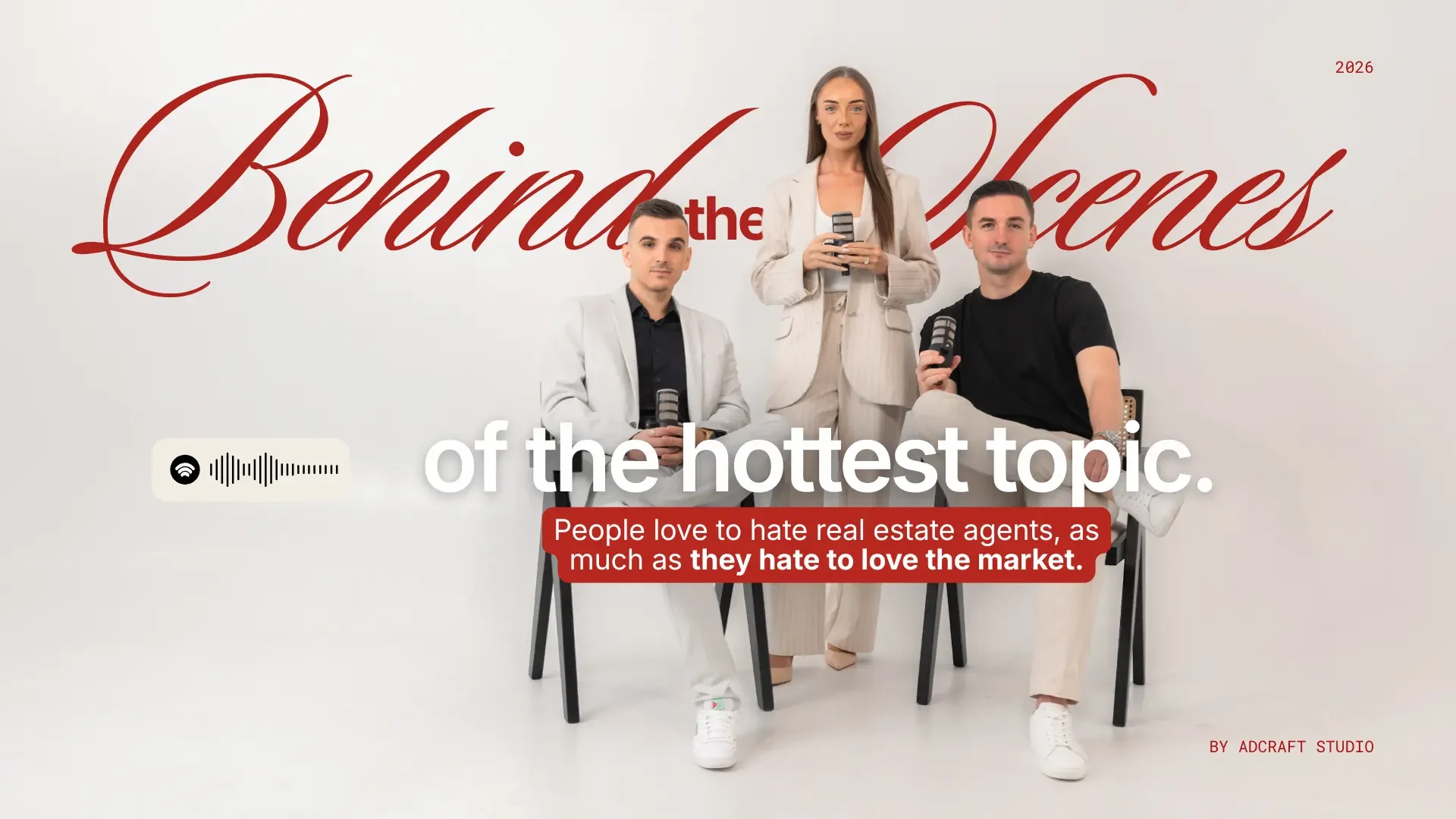
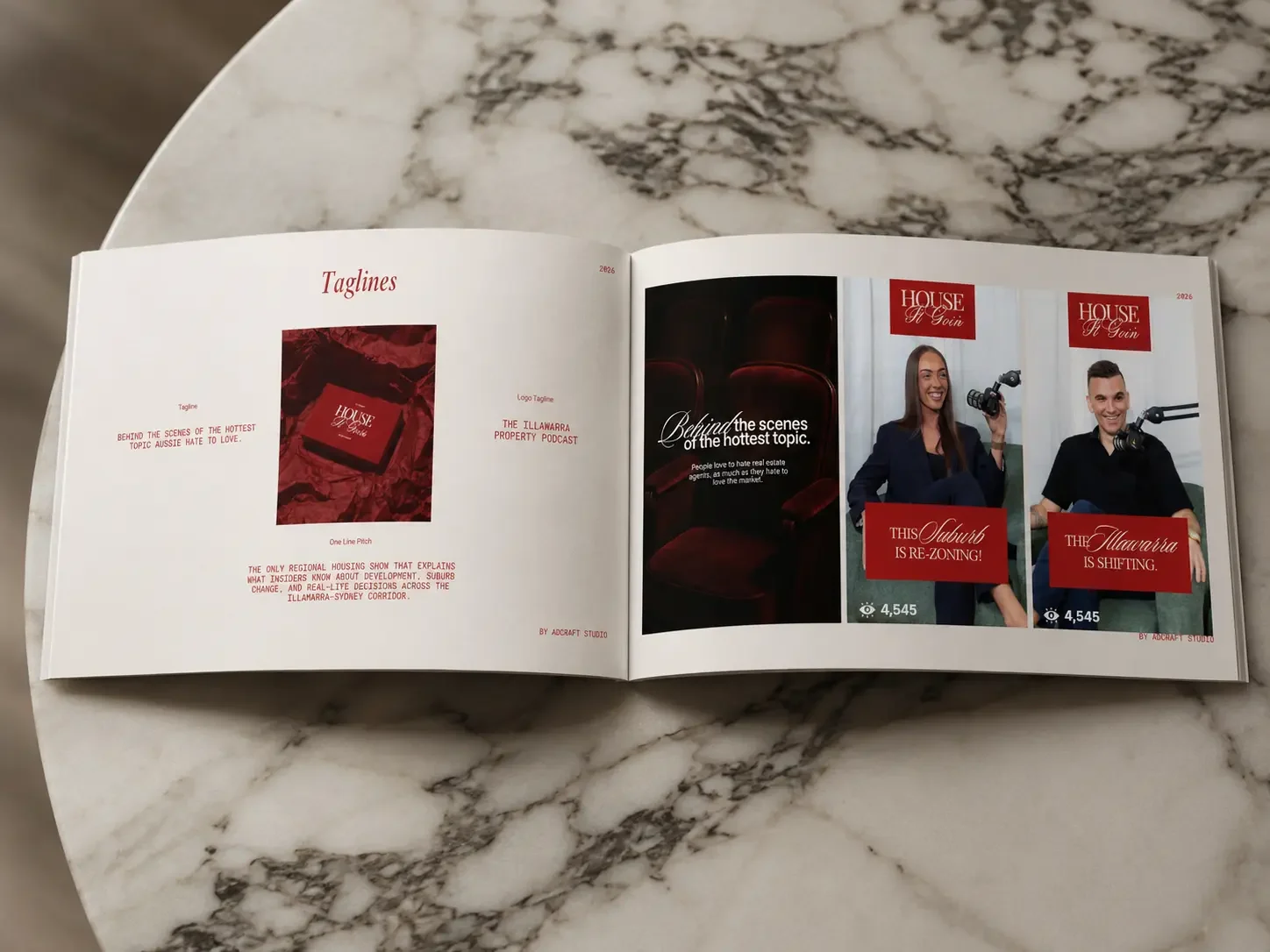
The topic everyone hates to love.
The line recognised the Australian audience’s complicated relationship with property.
Property is discussed at dinner tables, barbecues, workplaces and family gatherings. It represents security, aspiration and the possibility of wealth. It also produces anxiety, resentment, debt and exclusion.
People complain about the market while following it obsessively. They may distrust the industry and remain fascinated by every movement.
The tagline did more than identify the subject of the show. It recognised the audience’s emotional relationship with it.
That recognition created belonging. Whether fascinated, frustrated or reluctantly obsessed, listeners could see part of themselves inside the brand.
This is the function of a strong verbal identity. It gives the brand language that the audience can recognise, remember and eventually repeat.
Visual identity should convey the concept
Once the position was defined, the visual system could express it.
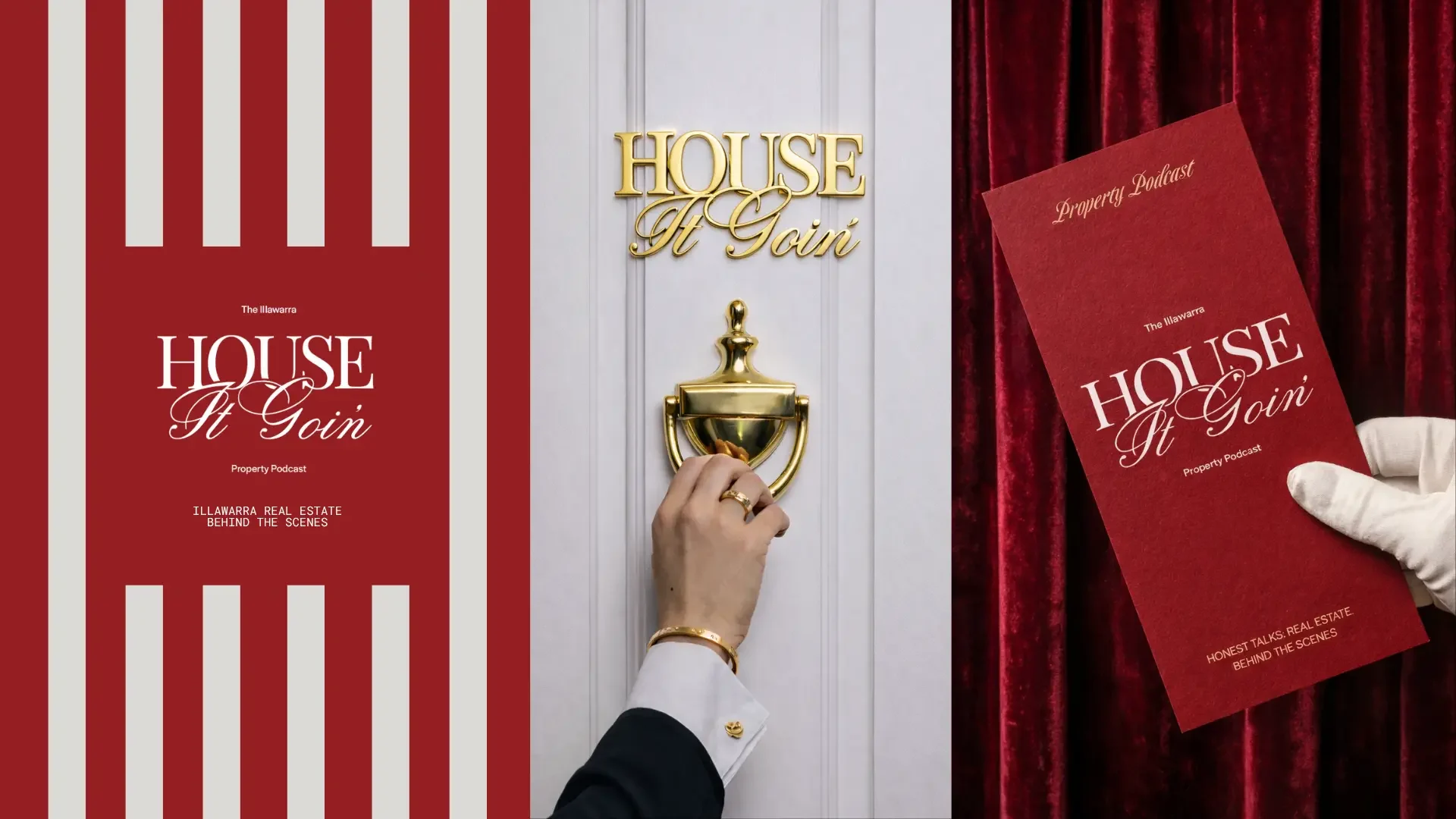
The selected House It Goin’ identity combined a high-contrast serif with an expressive script.
The serif introduced authority and editorial composure. The script interrupted that formality with movement, warmth and conversation. The tension between the two reflected the nature of the programme itself: property is consequential and technical, while the dialogue between the hosts is lively, candid and humorous.
The mark was developed into stacked, horizontal, enclosed and simplified versions.
This flexibility matters because a media brand rarely appears under ideal conditions. It must remain recognisable as a podcast cover, website header, social media profile image, vertical video graphic, printed application and small digital icon.
Consistency does not require the endless repetition of one rigid composition. It requires a recognisable visual grammar.
The colour palette centred on crimson and greige, supported by mist blue, white and black.
Crimson gave the brand confidence and cultural weight. It suggested editorial mastheads, theatre curtains, cinema interiors and lacquered architectural surfaces. Greige introduced restraint, while mist blue gave the system lightness and a subtle coastal quality.
The palette deliberately moved away from the conventional blue of financial services and the black-and-gold language frequently used in luxury real estate.
The purpose was not simply to look different. It was to establish a cultural atmosphere that sat between institutional property communication and informal creator content.
Art direction is reputation management
Photography and video direction are especially important for personality-led shows because the people are the product.
Conventional real-estate portraits would have returned House It Goin’ to familiar category cues: rigid poses, conspicuously corporate settings and the visual performance of professional success.
An excessively casual podcast aesthetic would have produced the opposite problem. The show could have appeared improvised and temporary.
The hosts needed to look like people whose opinions were worth hearing.
We developed an editorial direction influenced by magazine portraiture, classic cinema and a restrained 1990s atmosphere. Soft lighting, warm film tones, tactile materials, movement and asymmetrical compositions gave the imagery personality without sacrificing authority.
A crimson curtain became a recurring visual device. It concealed and revealed, giving visual form to the idea of opening the gates and showing what happens behind the property industry’s public façade.
Newspapers and documents referred to information, commentary and professional knowledge without turning the environment into a literal catalogue of real-estate symbols.
Corporate portraiture often communicates availability for business.
Editorial portraiture communicates the presence of a point of view.
House It Goin’ required the latter.
A show also needs a system for behaving
Branding cannot conclude with a logo package and a collection of photographs.
Shows are formed through repetition.
Each new episode, clip, caption and guest appearance contributes to the audience’s understanding of the brand. Without a content structure, every release becomes a separate marketing exercise.
For House It Goin’, the engagement therefore extended into recurring content formats, host profiles, social media templates, photography and video direction, an editorial calendar, and a proposed website structure.
The system allowed full conversations to become shorter, recognisable pieces of content without forcing every post into an identical template.
It also separated discovery from depth.
Short-form content could introduce the show to new people. Full episodes could establish familiarity. Host profiles and digital pathways could allow commercial interest to develop naturally.
The audience was not expected to move from first exposure to enquiry in one leap.
The brand created a sequence:
Curiosity became recognition.
Recognition became familiarity.
Familiarity could eventually become trust.
Personal brands need coherence without sameness
A multi-host show presents another challenge: the brand must contain several personalities without flattening them into a single corporate voice.
House It Goin’ involved three professionals with different dispositions, areas of knowledge and ways of communicating.
Their differences were valuable. They gave the audience several points of connection and made the conversations more dynamic.
The shared identity provided coherence while allowing each host to maintain an individual role.
This principle applies to partnerships, founder-led companies and professional teams. People rarely connect with a collection of biographies that all repeat the language of passion, experience and commitment.
They connect with recognisably different people united by a shared conviction.
A successful show brand therefore creates a common world without making everyone inside it identical.
What should a podcast branding project deliver?
The precise scope will vary, but a complete podcast or show identity may include:
- commercial and cultural positioning;
- audience definition;
- brand essence and central idea;
- messaging hierarchy;
- verbal identity and tagline;
- programme description and host profiles;
- logo architecture;
- colour and typography systems;
- photographic and video art direction;
- motion and editing principles;
- podcast-cover and platform applications;
- social media templates;
- recurring episode and content formats;
- guest and partnership criteria;
- editorial calendar;
- website structure and audience pathways;
- comprehensive brand guidelines.
The value of these deliverables is not limited to their immediate appearance.
A strong style guide gives the people behind the show a framework for making future decisions independently. It explains how the brand should speak, look and behave after the original designers, photographers and strategists have completed their work.
The objective is autonomy without drift.
So, do podcasts and shows need branding?
A casual conversation between friends does not require an elaborate identity system merely because it is being recorded.
A podcast intended to build a reputation, develop an audience, attract partners, create professional opportunities or strengthen a business does.
The production is entering a competitive market for attention. Its audience will encounter it among thousands of other voices, images, clips and claims.
Increasing production volume will not resolve that competition. AI has already made volume abundantly available.
What remains scarce is recognisable human judgement.
A successful show gives that judgement a form. It establishes an idea, defines its relationship with an audience and creates enough consistency for familiarity to develop over time.
The logo matters because it represents that idea.
The photography matters because it affects how the hosts’ authority is perceived.
The language matters because it determines whether the audience feels addressed or merely targeted.
The content system matters because reputation is built through repeated behaviour.
Branding gives all these elements concordance.
For House It Goin’, the result was the transformation of a promising podcast into an established media brand with a defined position, a recognisable personality and a system capable of supporting future growth. The client received more than a group of finished assets. The hosts received a framework through which every future episode, campaign and opportunity could contribute to the same commercial and cultural purpose.
As synthetic content becomes increasingly common, that coherence will matter even more.
People will continue searching for signs of genuine authorship: a consistent voice, a recognisable face, an intelligible point of view and evidence that somebody has considered why the content deserves to exist.
Podcasts and video shows are exceptionally well suited to providing that evidence.
Branding ensures that people recognise it.
Ben, one of the hosts, wrote in his review to Adcraft:
“We recently worked with Adcraft on our rebrand and couldn’t be happier with the result. The team was creative, responsive, and genuinely invested in understanding our brand and audience. A special mention to Sofia — she was outstanding throughout the process, keeping everything on track and making the experience seamless from start to finish.”


