How Service Businesses Can Use Customer-First Strategies to Be More Competitive.
by Sofia Cavalli
We are living through what the ancient Greeks called a καιρός, a critical moment of both risk and opportunity.
Meaning: we are in the middle of a market reset.
Not the kind that comes with fanfare or headlines, but the kind you notice when your lead flow slows, your ads stop converting, and your customers expect more than what used to be enough.
This shift is not a theory. It is structural.
And for service businesses, from law firms to electricians to consultants and real estate agencies, it requires a new operating model.
One that puts the customer not at the end of the pipeline, but at the centre of the system.
Today’s clients expect you to be flexible, responsive, and customer-first.
That means deeply understanding modern consumer behaviour: how your customers research, what they expect from you, and how they decide whom to trust.
In this article, we’ll explore:
✅ What’s changing in the service business landscape;
✅ What terms like “Product-Led Growth” and “customer-first strategy” really mean (in simple language);
✅ Practical steps you can take to stay ahead, even if you’re not a marketer;
Let’s dive in.
Why Traditional Sales Tactics Are Now Failing Service Businesses
Traditional service marketing relies on push tactics: cold outreach, lead generation forms, sales calls, discounts, "talk to us" CTAs.
But here's what's happening: the people you serve are no longer waiting to be convinced.
This is what we call a customer-pull environment. And in this context, businesses that continue to operate like it's 2012 are being filtered out.
Today’s buyers don’t sit back and wait for you to tell them what they need. Instead, they:
- Search online for solutions
- Read reviews and check ratings
- Ask peers and social networks for recommendations
- Want to experience value instantly, not after a long sales pitch
In short, control has shifted to the customer. And if your business still leans heavily on outbound tactics, you’re missing the boat.
Big takeaway: Your brand is no longer defined by what you say. It’s shaped by what your customers say. As Marty Neumeier puts it: “Your brand isn’t what you say it is. It’s what they say it is.”
What Is a Customer-First Strategy (And Why Does It Matter)?
Let’s clarify a few terms that are shaping how service businesses grow today.
✅ Product-Led Growth (PLG)
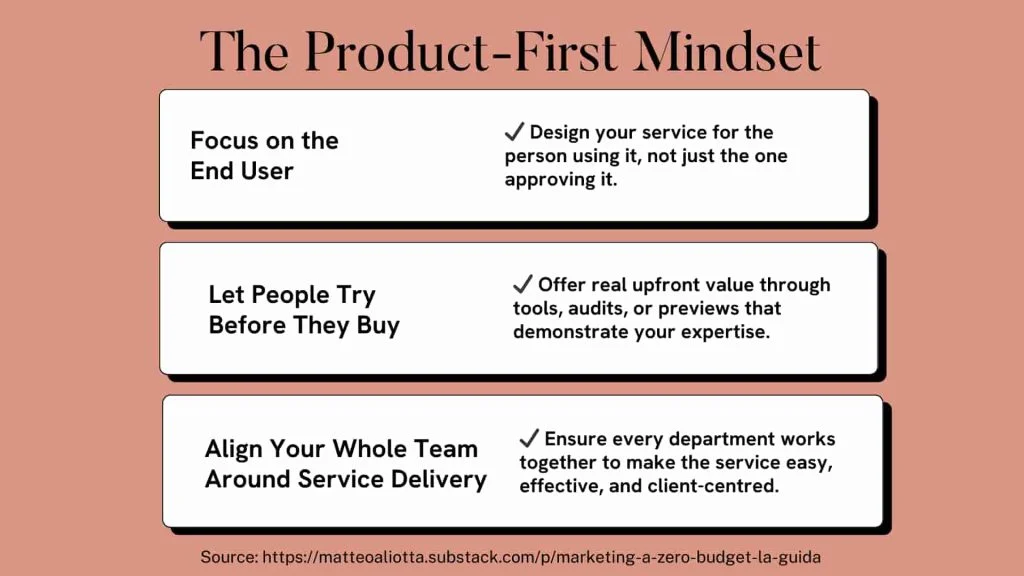
This means letting your product or service sell itself. Instead of relying on a big sales team, you make it easy for people to try your service before they buy.
Example: Canva lets anyone start designing for free. No pressure, no gatekeeping. That trial experience is what converts users into paying premium customers.
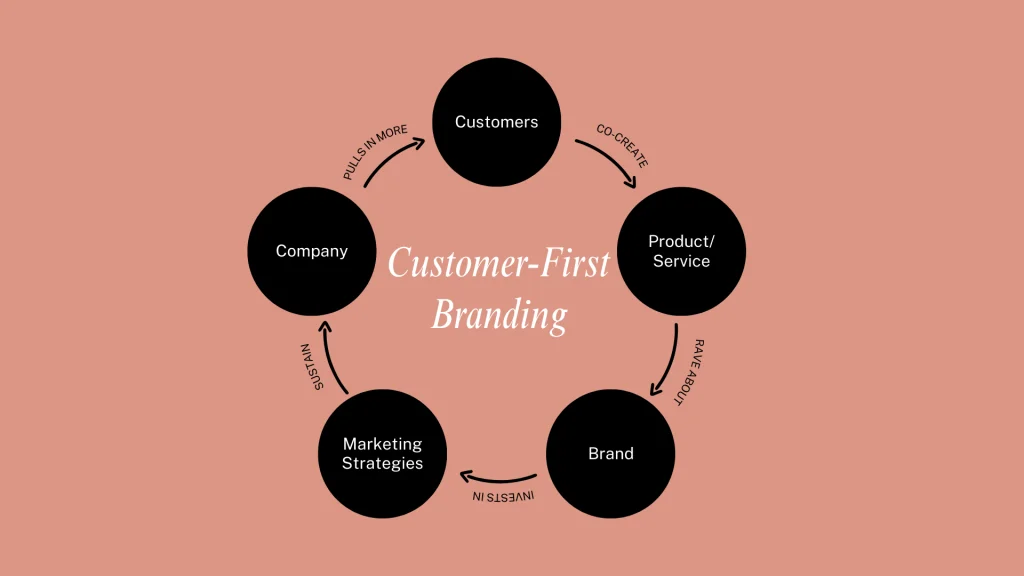
✅ Customer-First Approach
This is about putting the customer’s needs and experience first, not just your sales goals. It means:
- Making your services simple to access
- Designing processes that are clear and intuitive
- Creating value before asking for commitment
It’s about shifting your mindset from “How do we sell more?” to “How do we help more?”
✅ Mindshare vs Market Share
We all know market share: the number of sales you secure.
But in a digital-first world, mindshare is just as important. This is how strongly you live in your customers’ minds, how much they:
- Remember you
- Talk about you
- Recommend you
Big takeaway: Your brand is no longer defined by what you say. It’s shaped by what your customers say. As Marty Neumeier puts it: “Your brand isn’t what you say it is. It’s what they say it is.”
The Rise of Product-First Thinking in Services
Let’s zoom in on one idea that is reshaping not just how software companies grow, but how service businesses can thrive: Product-First Thinking.
Born from the SaaS world, this approach treats your offer as the core engine of acquisition, retention, and growth.
It’s not about ads or funnels. It’s about making your service feel like a product: clear, tangible, and self-explanatory.
Here’s how to translate product-first into the world of services:
1. Let Clients Experience Value Early
Much like a "free trial" in software, let prospects test the waters:
- A free legal health check
- A site inspection with basic recommendations
- A diagnostic consultation or audit
If your value is clear before they pay, they’ll pay more willingly.
2. Package Your Service Like a Product
Move away from vague offers. Define the scope, deliverables, and outcomes:
- List clear service tiers
- Show what's included at each level
- Use consistent language across web, emails, and proposals
Clarity beats persuasion.
3. Make the Experience Repeatable
Create assets and systems:
- Templates and frameworks
- Educational touchpoints (e.g. onboarding kits)
- Feedback loops to improve delivery
Great services, like great products, get better the more they’re used.
4. Design for Discovery
Let the customer discover your value step by step:
- Create interactive tools and calculators
- Use automated flows to onboard enquiries
- Showcase social proof and client wins
Your service should be usable before it’s purchased.
What’s Changing for Service Providers Right Now?
The line between B2B (business-to-business) and B2C (business-to-consumer) is blurring fast.
Even in traditional sectors like legal services, electrical contracting, or real estate, today’s clients expect consumer-like experiences. They want:
- Clear, simple offers
- Tools they can use themselves
- Opportunities to “test drive” your service before committing
This isn’t just about being trendy. It’s about survival.
If you fail to deliver the seamless, empowering experience your clients expect, they’ll simply choose someone who does.
5 Practical Ways to Build a Customer-First Service Business
You don’t need a marketing degree to put these ideas into action. Here are five proven strategies that any service business can start using today.
1️⃣ Offer a Low‑Friction First Step
Instead of asking clients to make a big commitment upfront, give them a small, no-risk entry point.
Examples:
- A law firm offering a free online legal health check
- An electrician providing a complimentary site safety or energy audit
- A real estate agency offering a free instant home valuation tool
Why it works: Clients want to test the waters. By providing value upfront, you build trust and lower the barrier to engagement.
2️⃣ Build Tools That Show, Not Tell
Stop telling people you’re great, show them.
Create tools, guides, or resources that let prospects experience your expertise first-hand.
Examples:
- A lawyer sharing a free contract checker tool
- An electrician offering an online energy savings calculator
- A real estate agent providing a rent vs buy calculator
Why it works: When prospects feel the value themselves, they’re far more likely to believe in your capabilities.
3️⃣ Let Prospects Self‑Navigate
Modern buyers hate friction. Don’t force them to email or call just to understand what you offer. Make everything transparent and accessible online.
Examples:
- A law firm listing clear package options on its website
- An electrician detailing maintenance plans with upfront pricing
- A real estate agency showcasing side-by-side package comparisons
Why it works: People like to feel in control. The easier it is for them to explore your offers, the more likely they are to move forward.
4️⃣ Turn Clients into Raving Fans
Word of mouth is gold. But don’t leave it to chance, systematise it.
Examples:
- Ask for referrals and reward clients with a small gift or discount (*Note: Encouraging referrals is a great way to grow your practice, but healthcare businesses must proceed carefully. Due to strict advertising regulations, such as those set by AHPRA in Australia, offering gifts, discounts, or other incentives in exchange for referrals is not permitted. Instead, focus on delivering exceptional care that naturally inspires patients to share their experience with others).
- Collect client testimonials and feature them on your site
- Run social campaigns that celebrate your clients’ wins
Why it works: Trust in peers is stronger than trust in advertising. A happy client can become your most powerful sales asset.
5️⃣ Involve Clients in Shaping the Service
Clients nowadays expect to co-create their experience.
Examples:
- A lawyer offering tailored service plans for business clients
- An electrician providing customisable service modules based on a building’s needs
- A real estate agent co-developing marketing strategies with sellers
Why it works: Continuity beats reacquisition. Adaptive offers lock-in lifetime value.
Bonus Tip: Don’t Ignore the Digital Journey
It’s no longer enough to have a slick website or clever ads. Your real edge comes from creating a seamless, connected experience across every digital touchpoint.
1️⃣ Map the Journey
List every digital touchpoint: website, social media, ads, emails.
👉 Sketch the full path clients take from discovery to enquiry. Spot gaps or friction points.
2️⃣ Remove Friction
- Clear, intuitive menus
- Mobile-first design (fast, easy to use)
- Simple booking/enquiry forms
👉 Test the full process yourself. Fix anything confusing or slow.
3️⃣ Stay Consistent Across Channels
Unify your message, offers, and look across:
- Website
- Social media
- Emails
- Ads
👉 Audit for mismatches and align everything.
4️⃣ Make Next Steps Obvious
Always guide users forward:
- Clear CTAs (“Book Now”, “Get a Quote”)
- Direct links in posts and emails
👉 Check: Is it obvious what to do next, everywhere?
🏆 Final Takeaway: Growth Becomes Compounding When Clients Carry the Brand
A customer‑first brand is formed in conversation, not in a boardroom. When clients grasp your value in minutes, experience it without friction, and feel included in shaping the outcome, they carry your story forward.
That story travels faster than any advertisement. It converts warmer, costs less, and endures longer.
Design services for that transfer of story and your growth curve will resemble a flywheel, not a funnel.
If you need help with this, let us audit your brand for you. Get in touch here.